Competence Decompensation: The Strategic Survivor
Healthcare may unintentionally punish competent nurses, fueling burnout, strategic disengagement, and a workplace culture that rewards survival over excellence.
Whitley Farmer
7/21/20262 min read
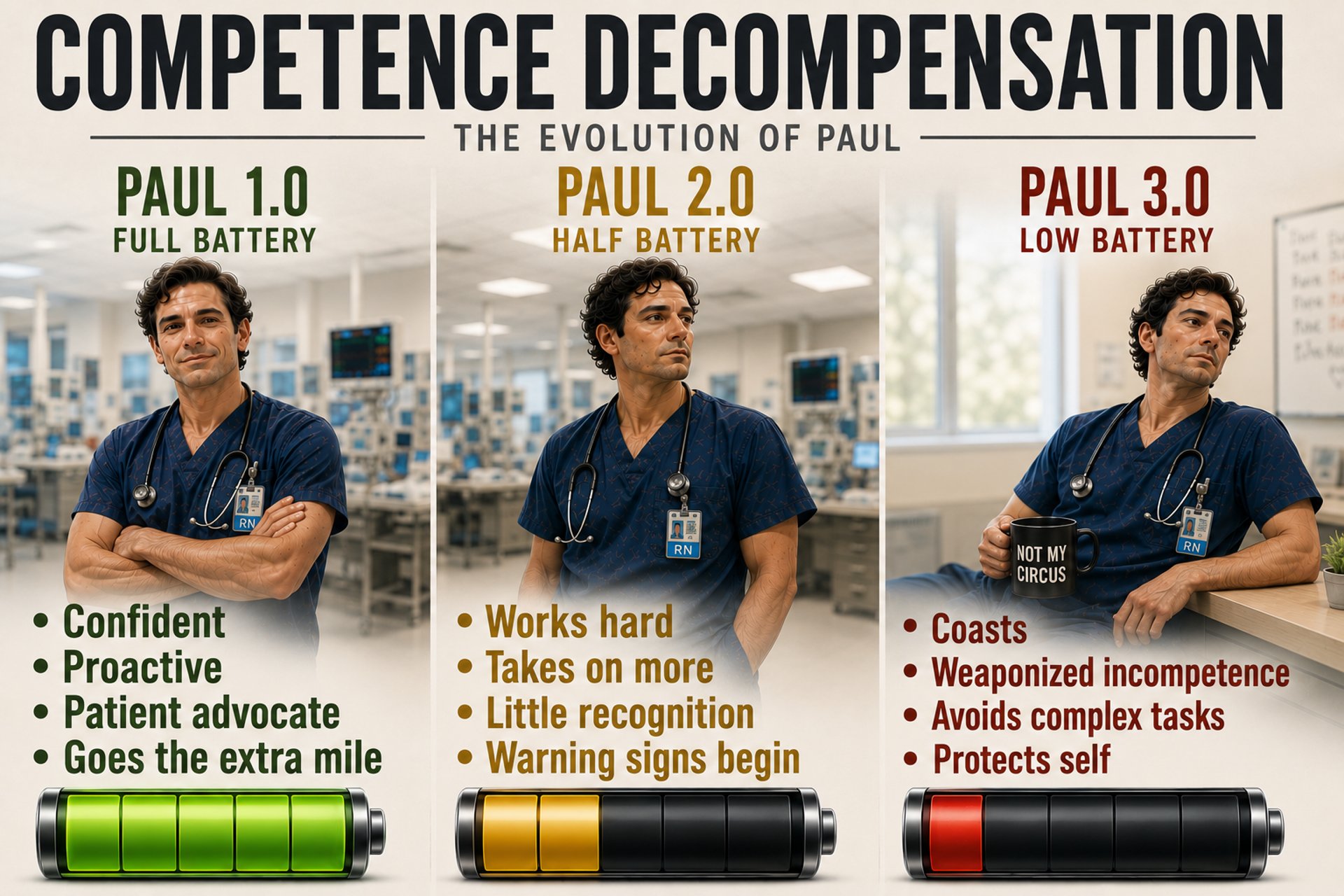
I once knew this nurse named Paul. He always answered his call bells right after the CNA did. Sometimes he would be on lunch right before he was about to get an admission, and when it was time to do complicated interventions like continuous bladder irrigations or giving TPN, he always “needed help” or simply didn’t know when things were occurring.
Everyone on the unit would talk about him, saying they didn’t know how he became a nurse.
But over time, I came to know a different side of him.
I am naturally talkative and open, and I would have lengthy conversations with Paul. At times, I would ask him questions about things I was unsure about, and surprisingly, he always knew the answer.
Then one day, one of his patients went pulseless.
Paul led the room with precision, step by step, until the rapid response team got there. As a former ER nurse, I could tell that wasn’t just luck.
It made me question whether what I had been seeing was actually weaponized incompetence.
Before I go any further, I’m not suggesting that everyone who appears disengaged is secretly highly competent or that poor performance is strategic. I’m sharing one conversation that challenged the way I think about competence, survival, and the incentives we create in healthcare.
I approached Paul afterward to debrief. I told him how impressed I was with the way he handled the code and how that level of competence didn’t always seem to translate into his everyday work.
He told me it did.
He said that, in order to survive, he had learned to keep himself and his patients safe. He told me a story about when he used to go the extra mile, and all it got him was harder assignments, more stress, and a back injury, he said jokingly.
I left that conversation battling with what I had just heard.
It went against what I understood about patient care, but it also made me wonder if this was the lesser of two evils.
Not because weaponized incompetence is the answer…
But because what if competence has become something the system punishes?
If competence in nursing is a punishment, then weaponized incompetence could be the solution.