
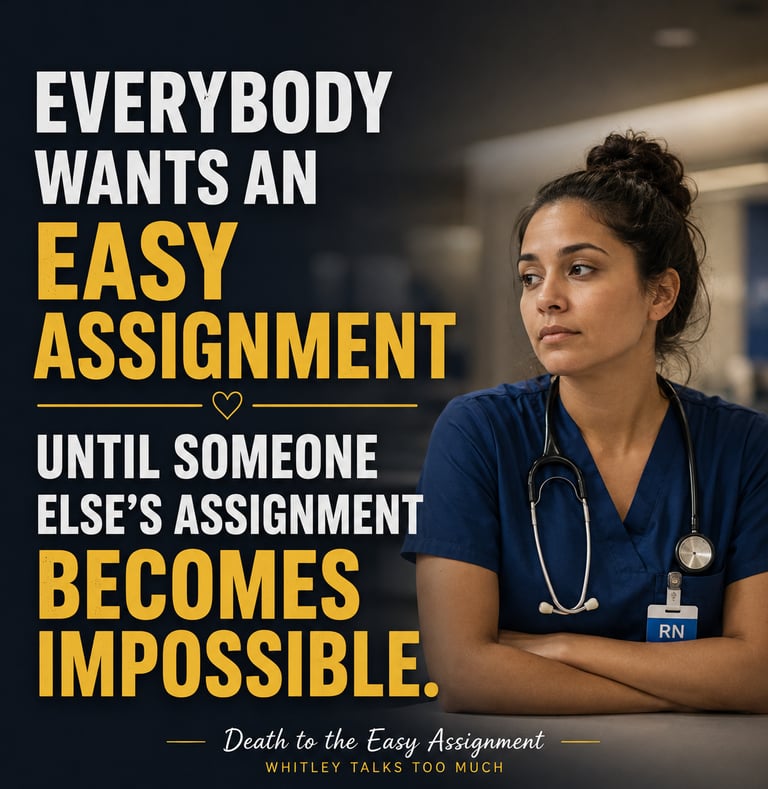
Death to the "Easy Assignment"
What if some of nursing's biggest systemic problems could begin to change with something as simple as how we arrange the unit assignment?
7/14/20262 min read
What if the pitfalls of nursing didn't rest solely on the shoulders of leadership?
We often look to administration, executives, and policy makers as the source of our frustrations, and many of those frustrations are justified. They control staffing models, budgets, productivity, and policies that directly affect bedside care. But what if that isn't the whole story?
What if the culture of nursing is just as responsible as the systems that govern it?
I wonder if many of the problems we experience on a unit level eventually become the problems leadership tries to solve on a larger scale. Poor communication, favoritism, gossip, territorial behavior, and the constant pursuit of the "easy assignment" don't originate in a corporate office. They happen at the bedside, in report rooms, and at the nurses' station. Over time, those behaviors become culture, and culture eventually becomes expectation.
New graduates often enter nursing with bright eyes and a genuine desire to work hard. Yet many seem to become dissatisfied much sooner than the generations before them. Is that because nursing has become objectively worse?
Or because they're being indoctrinated into a culture that has accepted exhaustion as inevitable and convinced itself that nothing will ever change?
I'm honestly not sure.
Whenever someone whispers an idea that sounds hopeful, someone else has a dozen reasons why it won't work. Sometimes those reasons are legitimate. Sometimes they're born from years of disappointment. But I can't help wondering how many good ideas have died before they were ever given a chance simply because everyone had already decided they would fail.
What would happen if, instead of competing for the easiest assignment, we collectively decided that everyone would carry a moderately difficult one?
What if helping each other wasn't viewed as losing, but as investing in the kind of shift we all wanted to work? What if shared responsibility became more valuable than individual comfort?
Would it solve understaffing? No.
Would it eliminate burnout? Probably not.
Would it fix healthcare? Certainly not.
But would it change the culture we hand to the next generation of nurses?
I don't know.
Maybe leadership has more power than we think. Maybe bedside nurses have more power than we realize. Most likely, the truth lies somewhere in between. Real change probably requires both.
Sometimes I wonder if we've become so accustomed to surviving that we've forgotten how to build something better. And maybe the greatest obstacle to improving nursing isn't that change is impossible—it's that too many of us have already decided