

Shared Responsibility, Individual Consequences: The Real Cost of Nurse Short Staffing
The real cost of nurse short staffing: patient safety risks, cognitive overload, missed care, and individual accountability in healthcare.
6/23/20263 min read
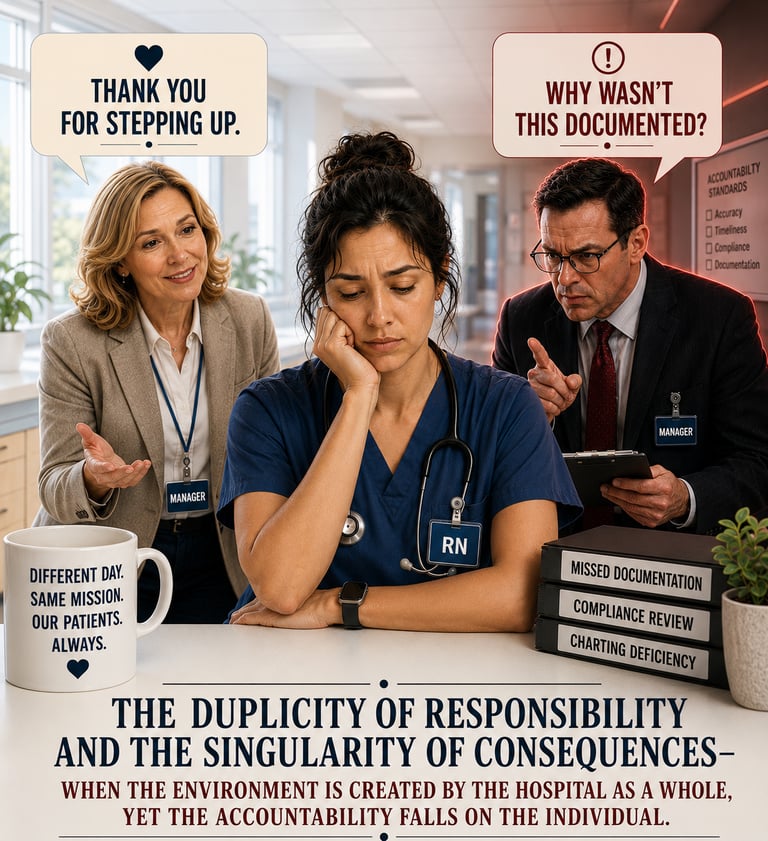
“The real effects of short staffing feel heroic in the moment but punishable by law afterward.”
A thank-you email for surviving the shift.
A compliance email the next morning.
Both can be true.
This leaves nurses in a difficult position.
There is honor in caring for people despite limited resources. Most of us don't want to refuse assignments. We don't want to abandon our coworkers. We don't want to make a scene every time staffing is short or resources are stretched.
So we adapt.
We skip lunch.
We work faster.
We prioritize.
We carry more than we should.
Then the shift ends.
The group chat thanks everyone for pulling together.
The audit email identifies the missed documentation, missed reassessment, or missed task.
In the moment, we are a team.
Afterward, accountability becomes individual.
And that's the uncomfortable reality of modern nursing: the system often depends on nurses compensating for its shortcomings while still holding them solely responsible for the consequences.
Both messages can be true.
That's what makes it so difficult.
What makes this conversation even more uncomfortable is that the effects of understaffing are no longer anecdotal.
They are measurable.
The Research Behind the Reality
What makes this conversation even more uncomfortable is that the effects of understaffing are no longer anecdotal.
They are measurable.
Cognitive Overload Is a Patient Safety Issue
Short-staffed environments force healthcare workers to continuously switch between complex tasks. This constant multitasking creates cognitive overload, increasing the likelihood of missed warning signs, overlooked procedures, and forgotten steps.
The issue is not competence.
The issue is capacity.
Even highly skilled professionals become more vulnerable to mistakes when workload consistently exceeds available mental bandwidth.
Fatigue Multiplies Risk
Understaffing often leads to longer hours, missed breaks, and chronic fatigue.
As fatigue increases, cognitive performance declines.
Decision-making slows.
Attention becomes fragmented.
Memory becomes less reliable.
In healthcare, where hundreds of decisions may be made during a single shift, even small decreases in cognitive performance can have significant consequences.
The Data on Patient Outcomes
The consequences extend beyond staff wellbeing.
Research from the University of Pennsylvania School of Nursing found that each additional patient added to a nurse's workload was associated with approximately a 7% increase in inpatient mortality.
Other studies have linked high patient-to-nurse ratios with:
Increased medication errors
Missed nursing care
Delayed interventions
Higher rates of adverse events
Increased patient mortality
These findings suggest that staffing is not merely a workforce issue.
It is a patient safety issue.
Why Nurses Often Feel Trapped
The challenge is that nurses are placed in an ethical dilemma.
Most nurses do not want to refuse assignments.
Most nurses do not want to leave coworkers struggling.
Most nurses do not want patients to suffer because resources are limited.
So they adapt.
They compensate.
They absorb the pressure.
The problem is that human adaptability can hide system failures.
A nurse who skips lunch to keep patients safe may prevent harm that day.
But when an entire workforce relies on personal sacrifice to compensate for structural shortages, risk accumulates beneath the surface.
The Difference Between Accountability and Blame
This is not an argument against accountability.
Healthcare requires accountability.
Patients deserve accountability.
Professionals deserve accountability.
But accountability should not prevent honest conversations about the environments in which care is delivered.
A system can be understaffed and a nurse can still be accountable.
Both can be true.
The danger comes when individual mistakes are examined without examining the conditions that made those mistakes more likely.
Because patient safety improves most when healthcare organizations learn from both.
The individual action.
And the system that shaped it.
The duplicity of responsibility and the singularity of consequences—when the environment is created by the hospital as a whole, yet the accountability falls on the individual.
For years, nurses have described the feeling of being spread too thin—trying to balance competing priorities, interruptions, admissions, discharges, medication administration, patient education, family concerns, and documentation requirements simultaneously.
Research suggests that what nurses experience as "being overwhelmed" has a scientific explanation.